
With infinite wisdom just one quick Google search away, there’s no doubt that the sheer amount of health information out there can be overwhelming.
As a doctor – and someone who cares deeply about helping people navigate their own health journeys with confidence – I’ve seen firsthand how misinformation can quietly infiltrate the health and wellness world. And thanks to social media platforms like Instagram, TikTok, YouTube, and Facebook, anyone with a camera and an opinion can call themselves a “health expert.” Sometimes it’s harmless. Other times, and increasingly more often than not, it’s dangerous.
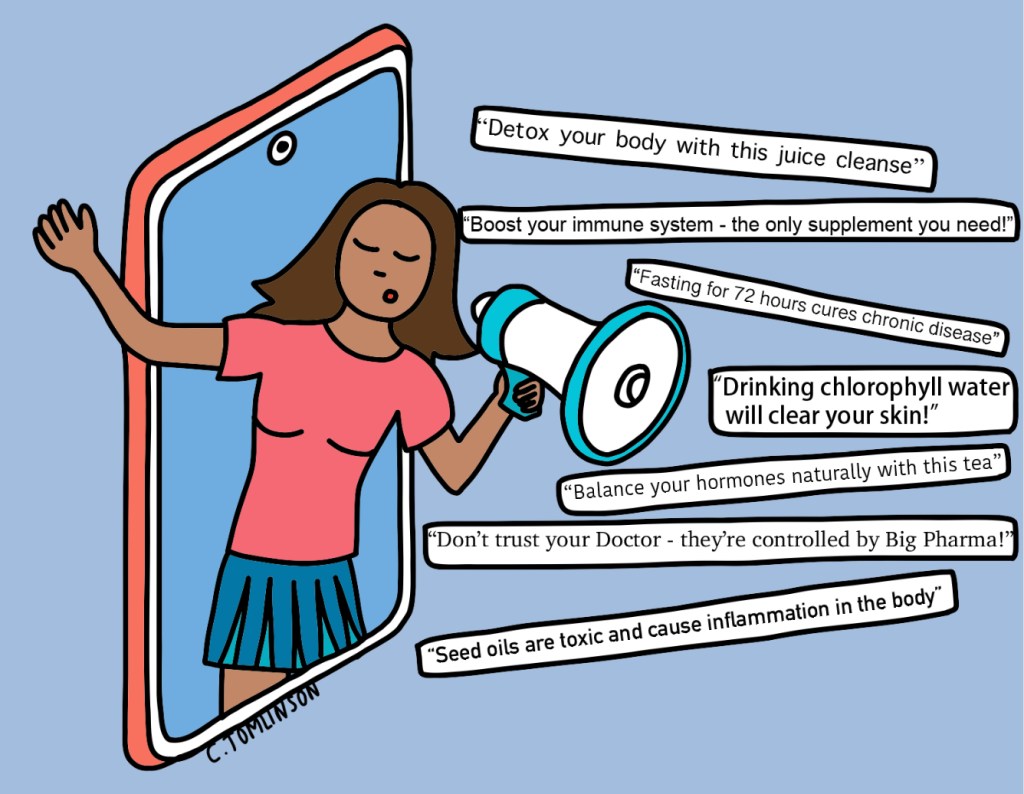
A few weeks ago, my partner showed me an Instagram ad claiming that Vitamin D supplements are actually harmful for you – he asked me if this is true as he hadn’t heard of this before. Now, to be clear, not all supplements are worth your money, and we’ll delve into this more at a later date. But when it comes to Vitamin D – especially in countries like the UK where many people are Vitamin D insufficient or deficient – there’s a very solid evidence base behind its use in certain groups of people. The fact this ad popped up on his instagram concerned me.
And this is where the problem lies; misinformation doesn’t always come in the form of obvious falsehoods. Often, it’s dressed in partial truths, emotional language, or pseudo-authoritative jargon, and appears often in situations where you’d expect to be able to trust the sources.
It can be hard to spot, even for the well-intentioned and well-informed.
So, with a wealth of information at our fingertips, how can we tell the difference between legitimate health information that is backed by science, and something that sounds science-y?
Contents
- What is pseudoscience?
- The top 10 red flags of pseudoscience
- The ‘Science’ checklist
- 3 questions to ask yourself before accepting a claim
- In summary – stay curious, stay critical
What Is Pseudoscience?
Pseudoscience refers to claims that are appear scientific, but which are not formed in a scientific way. They therefore lack the evidence, methodology, or openness to scrutiny that real science requires.
In philosophy, a pivotal concept is the demarcation problem – the question of how to reliably distinguish science from pseudoscience.
It’s not a question with a simple answer, but for the average person scrolling through wellness reels at midnight, there are some important red flags to look out for, and we’ll get into these now.
The Top 10 Red Flags of Pseudoscience
1. Lack of Scientific References
If a claim isn’t backed by peer-reviewed scientific research, be cautious. Peer review involves other experts in the field scrutinising the methods and findings of a study before it is published in a journal – this is how science holds itself accountable. Vague claims like “studies show” with no link to the actual research is a huge red flag.
As astronomer and planetary scientist Carl Sagan once said:
“Extraordinary claims require extraordinary evidence.“
2. Anecdotes Instead of Evidence
We’re all drawn to stories. “I started drinking celery juice every morning and my IBS disappeared!” might sound inspiring – but this does not translate into scientific proof. Personal anecdotes can be powerful, but they’re also highly subjective.
Pseudoscience often hides behind testimonials, before-and-after photos, and influencer “success stories.” But what works (or appears to work) for one person doesn’t prove effectiveness for the wider population, as health and medicine is highly individual.
Using science jargon in personal anecdotes does not automatically equate to science, either. Terms like “toxins,” “organic,” “natural,” and “energy”, may sound legitimate, but without context or data, they’re just marketing.
3. Consider The Source
Ask yourself: Who is saying this, and why should I believe them?
Are they a registered healthcare professional, researcher, or someone with relevant (and credible) expertise? Or are they an influencer, life coach, or entrepreneur with a product to sell?
Even if they’re well-intentioned, if their credentials are questionable, or if they’re operating out of the scope of their practice, it’s worth thinking twice before accepting a claim. They may have a large following on social media, but they could be spreading misinformation to the masses. Popularity is not the same as credibility.
4. Claims That Sound “Too Good To Be True”
If it sounds too good to be true, it probably is. Be skeptical of any claim that promises instant results or guaranteed outcomes – there is no “one-size-fits-all” quick fix in medicine. Health is complicated and highly individual; what works for one person may not for the next.
5. No Mention of Limitations or Side Effects
Every treatment, drug, or health recommendation has risks and benefits, and these always need to be considered in full to make an informed decision about your health. If something is being sold as 100% safe or risk-free, that’s a problem.
Legitimate science is transparent about uncertainty. It shares what we know—and what we don’t know. Pseudoscience pretends to have all the answers.
6. Cherry-picking Data
Selectively choosing evidence that supports your claim, while ignoring contradictory findings, is deceptive – and is also known as confirmation bias. A reputable source will consider and evaluate all evidence.
If someone cites a single study as definitive proof, they may be trying to sell you a narrative, not the truth.
7. Products or Programmes for Sale
Ask yourself: Is the purpose of the post to inform or to sell?
If there is a financial motive behind the advice given, it’s important to be even more vigilant. Influencers and content creators are legally required to clearly identify commercial content, under consumer protection law. Look out for words like “ad,” “advert,” and “advertising” on posts, as this will allude to whether someone has been incentivised to promote a brand or product in the information they are sharing.
8. Rejection of Mainstream Medicine
Watch out for phrases like “what doctors don’t want you to know” or “big Pharma won’t tell you this”, as this kind of language creates mistrust in evidence-based care and feeds conspiracy thinking. Narratives that frame conventional medicine as the enemy and present themselves as the “only truth” should be received with caution.
9. Speaking in Absolutes
Science speaks in terms of probability and risk. Pseudoscience speaks in black and white. Absolutes like “never” and “always” are rarely seen in peer reviewed health research, as an essential quality of science is its ability to be proven wrong when new evidence emerges.
A real expert may say:
“Evidence suggests this approach can help some people.”
A pseudoscientist will say:
“This will work for you.”
10. Fear Mongering
Fear sells, science informs. Pseudoscience often relies on emotional manipulation – dramatic headlines and emotional language act to bypass your logic and illicit a quick reaction, one that supports the claim they are making.
The ‘SCIENCE’ Checklist
Here’s a quick tool you can use any time you encounter health information online, and you’re unsure whether it’s reputable. Think ‘SCIENCE‘.
S – Simplicity: Is there a “one-size-fits-all”, or is there an overly simplistic mindset?
C – Commercial interest: Is someone profiting from this?
I – Influence: Who is making the claim? Are they a registered healthcare professional or credible expert?
E – Everywhere online or expert consensus: Is it popular on social media, or peer reviewed?
N – No absolutes: Are they using cautious scientific language, like “may help”, “suggests”, instead of “will cure”, “never fails”?
C – Calm or crisis: Is the message well-balanced, or designed to invoke fear, panic, and urgency?
E – Evidence or emotion: Is there hard data, or a personal story behind the claim?
3 Questions To Ask Yourself Before Accepting A Claim
The video below explains the demarcation problem further, using the pseudoscientific example of homeopathy. It is well worth a watch, but the key take home message is the need to ask yourself the following 3 questions before accepting a claim that you see online as the truth:
- Could we test this theory?
- Are the individuals behind this theory updating their claims with new findings?
- Is this consistent with our broader scientific understanding of the world?
In Summary: Stay Curious, Stay Critical
Health misinformation is not always obvious at first sight. It can be wrapped in slick branding, persuasive testimonials, and just enough scientific language to pass as credible.
Being health conscious and curious is a strength, but it needs to be paired with critical thinking; not all information should be accepted at face value.
And if you’re ever in doubt, remember this:
Real science welcomes questions. Pseudoscience shuts them down.
What was the most convincing piece of health information you’ve seen online, only to find out later that it isn’t backed by science? I’d love to hear from you!

 The Health and Healing Narrative
Leave a comment