
On the 23rd of October 2025, the British Medical Association (BMA) announced a new round of strikes, set to take place from the 14th – 19th of November. This will mark the 13th round of strikes since 2023, as resident doctors continue their fight over pay, training, and working conditions.
To understand why these strikes are happening, it’s essential to know who resident doctors are, how their NHS contracts have evolved over the last decade, and why previous disputes have escalated.
This article break downs the key strikes and contract disputes over the past decade, providing essential context for anyone following the NHS industrial action.
Contents
- Who Are Resident Doctors?
- Why Are Resident Doctors Striking?
- Contract Disputes and the First Strikes
- 2020s: Pay Restoration and Working Conditions
- Why This Timeline Matters
DISCLAIMER:
While I am a practising doctor, the information on this site is for educational purposes only. It does not take into account your personal circumstances, which can significantly affect medical decision-making and treatment. This content therefore does not constitute medical advice, and should not be relied upon for diagnosis or treatment. Always consult a qualified healthcare provider regarding any health concerns.
This article was written on the 27/10/2025 using up-to-date sources at that time. Please be aware that medical information and guidelines change often.
Who Are Resident Doctors?
Resident doctors are qualified doctors in clinical training. They were previously called junior doctors, but the BMA voted to replace this term in September 2024, arguing that it fails to reflect their professional expertise and responsibilities.
Here’s how the UK training pathway works:
- Medical school: This takes on average 4-6 years depending on whether it is an undergraduate or postgraduate programme.
- Foundation training (FY1 + FY2): A mandatory 2-year programme for newly qualified doctors. In FY1, doctors work under a provisional registration. After successful completion, they progress to FY2 and receive full registration with the General Medical Council (GMC).
- Speciality training: Doctors apply to one of over 60 specialties. Some programmes (like GP) are “run-through,” while others require further applications to progress. Specialty training can last anywhere from 3 years (for GP) to 7+ for most other specialities.
- Consultancy: After completing specialty training, doctors become eligible to apply for consultant posts – a process that typically takes 7–10 years after medical school.
“Resident doctor” therefore covers all doctors in postgraduate training – from newly qualified FY1s to senior registrars nearing consultancy. They make up over half of all doctors at any one time, delivering much of the NHS’s day-to-day clinical work. They are frequently your first point-of-contact in the NHS, and always work under the supervision of a senior doctor.
Why Are Resident Doctors Striking?
Though the situation is complicated and deserves a deeper dive in our next article, the strikes essentially stem from three key factors:
1. Pay Erosion
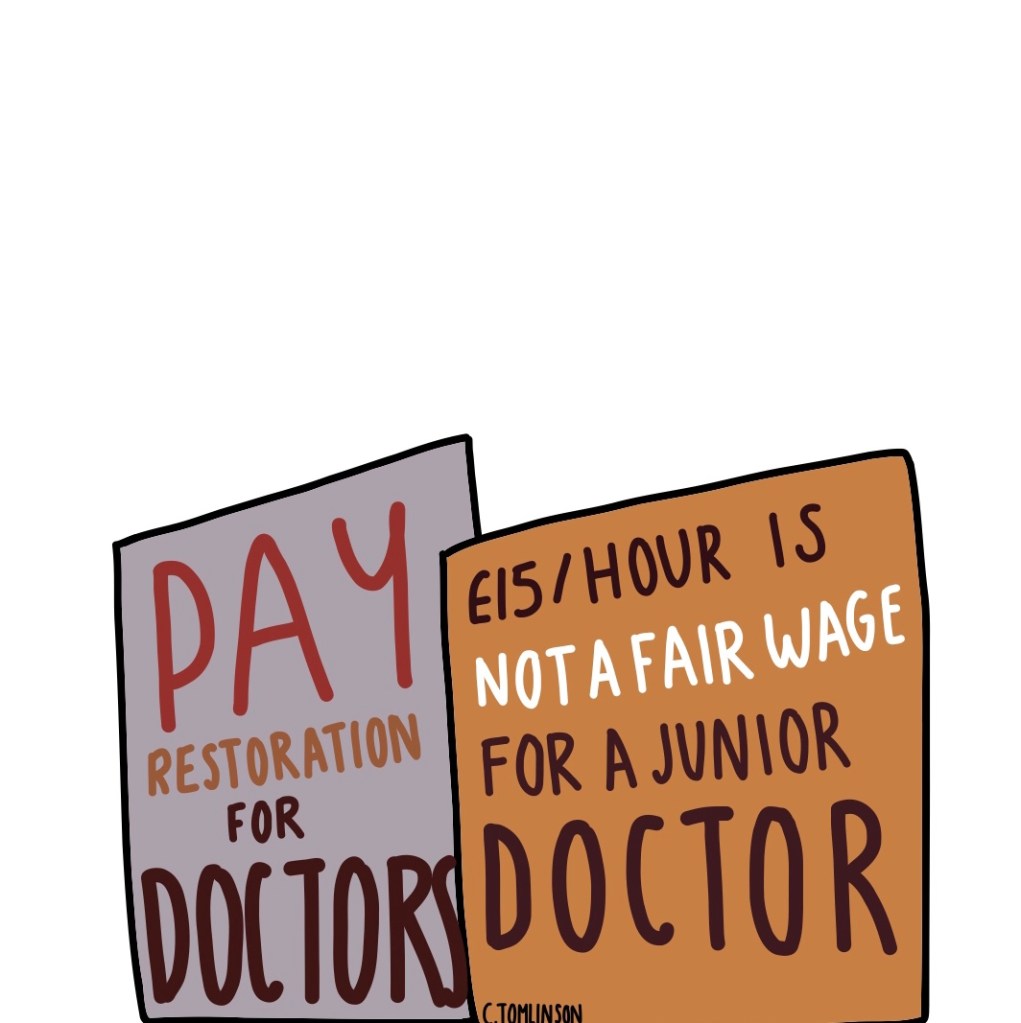
In 2025/26, despite recent pay deals, resident doctors still have a real-terms pay cut of 21% according to BMA calculations when compared to 2008/09 doctor’s salaries.
But wait, why does the government say resident doctors have had a 28.9% over the last 3 years?
Stay tuned for the next post where we’ll deep dive into this! To read about the BMA’s calculations in the meantime, click here.
2. Working Conditions and Staffing
Understaffing, rota gaps, and rising demand have created conditions that many doctors describe as unsafe and unsustainable, for both clinicians and patients.
3. Speciality Training Bottleneck
20,000 qualified doctors missed out on speciality training posts this year, due to a lack of formal training posts. This is a huge problem.
Looking into this further is beyond the scope of this article, but read The UK Doctor Bottleneck: Why Training Posts Are The Real Crisis for more.
Contract Disputes and the First Strikes
For just over a decade, resident doctors have been striking in the UK. Before the 2012 pension strike, there hadn’t been a doctor walkout since 1975.
2011 – Junior Doctor Contract to Be Renegotiated
- A report by NHS Employers describes existing contracts as “outdated“, “unfair“, and “no longer fit for purpose“. It proposes negotiating a new contract aimed at more flexible working patterns and rewarding clinical competence rather than hours worked.
2012 – Pension Strike
- 21 June: 24-hour strike over proposed NHS pension changes, following planned increases to pension contributions and retirement age. Negotiations continued after the strike.
- NHS England proposes that the NHS should provide seven-day access to routine services, and outline incentives that will be used to improve services from April 2013.
2013 – New Contract Framework Agreed
- BMA and NHS Employers agree “Heads of Terms” (HoT) to guide contract reform around pay, quality of life, hours, and training.
2014 – Talks Collapse
- October: The BMA walks away from contract negotiations, warning that current government demands could “jeopardise patient and doctor welfare.”
- Government asks the Review Body on Doctors’ and Dentists’ Remuneration (DDRB) to make recommendations on reforming contracts to support seven-day NHS services.
2015 – Contract Dispute and Ballot
- July: DDRB publishes recommendations for new contract, endorsing proposals to extend “standard hours” and reduce unsocial-hours pay.
- September: BMA refuses to re-enter talks after expressing a number of concerns about the new contract, supported by 11 Royal Colleges. Ballot for industrial action announced.
- 19 November: Ballot result: 98% vote in favour of strike action (76% turnout). Strike action planned for December. The BMA asks the Advisory, Conciliation and Arbitration Service (ACAS)* for their involvement.
- 30 November – ACAS mediates, leading to a four-week suspension of strike plans agreed.
*ACAS = an independent body that provides impartial advice on work-place practices, helping to resolve employer-employee disputes.
2016 – Escalation and Strikes
- 4 January: New government offer is made to the BMA. New offer includes the establishment of “safe working guardians” at each trust to monitor safe working hours.
- January – April: BMA rejects the offer. Four strikes take place: first three withdraw routine care; April strike includes emergency care (first “all-out” strike in NHS history).
- 11 February: Health Secretary announces contract will be imposed from August, stating a negotiated solution is not possible.
- 5 July: BMA members reject a revised deal put forward in May (58% against; 68% turnout).
- 6 July: Government proceeds with implementing new contract, but now with a phased rollout from October 2016–2017 (not August).
- 31 August: Further industrial action announced for September through December.
- September: Planned strikes are suspended over patient safety concerns.
2017 – Contract Rollout and Continuing Discontent
- 2016 junior doctor contract begins phased implementation across NHS trusts.
- No official strikes, but significant unrest continues as doctors report issues with new rota patterns, pay banding, and unsocial-hours pay.
2018 to 2019 – Review And Resolution
- September 2018: BMA and Government agree a full review of the 2016 contract.
- 26 June 2019 – Junior doctors accept a negotiated contract package, reported as an 8.2% pay rise over four years, ending the dispute.
2020s: Pay Restoration and Working Conditions
2022 – Renewed Pay Campaign
- June – The BMA calls for “full pay restoration” to 2008 levels, citing a real-terms loss of 26.1%. The BMA attempts to engage with the Health Secretary, asking for a 35% pay increase.
- July – Government announces a 4.5% pay rise for doctors with pay back-dated to April, below inflation (11.1%).
2023 to 2024 – Major Pay Dispute
- 20 February 2023: 98% of BMA members vote for strike action (77% turnout).
- March 2023 – January 2024: Ten rounds of strikes take place, including a record six-day walkout – the longest in NHS history.
- August 2023: Junior doctors in Scotland accept a pay deal of 12.4%, alongside a commitment from the Scottish government to continue to work towards full pay restoration.
- January 2024: Junior doctors in Northern Ireland ballot for strike action. First strikes for junior doctors in Wales take place.
- March 2024: Junior doctors in England vote to extend strike mandate into September (98% in favour, 62% turnout).
- 29 July 2024: Agreement reached on a 22.3% average pay rise over two years for junior doctors in England.
- September 2024: Doctors in England accept pay offer (66% in favour), ending the 2023-24 pay dispute. Junior doctors are now referred to as resident doctors as agreed between the BMA and government.
2025 – New Ballot and Broader Concerns
- January: Resident doctors in Northern Ireland vote to accept 4.05% pay rise.
- 27 May: BMA ballot of resident doctors in England: 90% support further strikes over pay restoration (55% turnout).
- 25–30 July: Five-day strike across England.
- 8 September: FY1 doctors ballot over the speciality training bottleneck and lack of training posts.
- 6 October: 97% of FY1s vote to strike (65% turnout).
- 23 October: BMA announces a five-day strike (14–19 November) over pay, job insecurity and limited training opportunities.
- November: BMA in Wales will hold a referendum over the new contract offered to junior doctors.
Why This Timeline Matters
The timeline reveals how each new dispute builds on unresolved issues from the last. What started as a debate over contract fairness and safe working hours has grown into a wider crisis over pay erosion, training bottlenecks, and the sustainability of the NHS workforce. Resident doctors warn that salaries have fallen behind inflation, working conditions are increasingly unsustainable, and training opportunities are shrinking year by year.
Understanding this history is essential to make sense of the November 2025 strikes and the ongoing debate over pay restoration and specialty training shortages. In the next article, we’ll take a closer look at the BMA’s pay calculations, explore why government and union figures don’t match, and what this might mean for the future of the NHS.
I’d love to hear your thoughts! Please leave a comment down blow.
Editor’s note: Discussion about topics like these is important, but can be contentious – please be kind with your words. There are always two sides to the story.


 The Health and Healing Narrative
Leave a comment