
Amid the ongoing uncertainty around training posts and job security within the NHS, one thing has become increasingly clear: each year, more doctors are choosing to move abroad.
Australia is often at the top of that list. Think sandy beaches, sunshine, an English-speaking workforce, and a healthcare system that looks – at least from the outside – comfortably familiar. It’s easy to see why heading “down under” has become so popular among UK graduates. But is it really as good as it sounds?
To find out, I spoke with Dr Kirtee Koushi Conhyedoss – Koushi for short – an emergency medicine (ED) doctor and GP trainee based in Perth. We explored the realities of working as a doctor in Australia, and why, in many ways, it’s not quite as different from the UK as we may think.
Our conversation has been adapted for readability.
Contents
- First of All – Can You Tell Me a Bit About You?
- Your Podcast – Tell Me More
- The Australian Health System – How Does It Actually Work?
- What’s It Like Day-to-Day as a Doctor in Australia?
- What Challenges Is the Australian Health System Facing?
- What’s the Appeal for UK Doctors?
- Are There Any Misconceptions About What It’s Like To Work as a Doctor in Australia?
- Do UK Doctors Adapt Well to the Australian Health System?
- Do You Have Any Advice For Doctors Thinking of Moving?
- Do You Think You’d Ever Work in The UK?
- In Summary
- More About The Speaker
First of All – Can You Tell Me a Bit About You?
Koushi: My name is Kirtee Koushi Conhyedoss, but I like to be called Koushi. I was born in Mauritius, grew up in the south of France, then moved east coast of Australia to study medicine, and eventually moved to the west coast of Australia to work as a doctor. I’ve been in Perth since 2019.
Charlotte: Oh wow! You’ve travelled a lot. What area of medicine you work in?
Koushi: I was an ED trainee for a few years, but I quit ED training this year and switched to General Practice (GP) training.
I still do shifts in the emergency department, and I’m planning to get the Advanced Diploma in Emergency Medicine because I love it.
But I felt that in ED, you don’t get the same continuity of care you get in general practice – so that’s why I switched. And also for the work-life balance, which is much better in GP training!
Charlotte: I can relate to that – I was in ED last year too, and was torn between GP and ED training – I decided on GP training though, and started this year. It’d be good to hear your thoughts on how you’ve found this switch so far, has it been an easy transition?

Koushi: I haven’t actually started working in the community yet – I’m still working in ED for the next couple years. It was a really big decision to quit emergency training though – at the beginning of the year, I really didn’t want to. But I knew it was the right decision, and now I’m at peace with it. I still get to do some ED while also doing GP too.
GP training feels less hectic though, and the support is amazing. They check up on you, they ask what you need for your career progression, they have one-on-one meetings… it’s such a big difference from ED.
Charlotte: I’m with you. It all sounds really positive – and it sounds like you get the best of both worlds: GP, but still some ED.
Your Podcast – Tell Me More
Koushi: It’s called The Junior Doctor Series Podcast: The Unspoken Truth. I’d wanted to create it for years. I felt something was missing in medicine – we don’t speak about the unspoken parts: we’re not taught how to deal with the death of a patient, or that burnout is a real thing, or what work-life balance actually means. You only understand it once you’re in the job.
I launched the podcast in 2024 when my mum was unwell. Creating it really helped me – helped keep my mind off things. At the same time, I wanted a platform and a community where everyone feels welcome, not judged, and could resonate with the realities we share. There are so many tips and lessons I wish I had known earlier in medicine – and I know others feel the same.
The Australian Health System – How Does It Actually Work?
Koushi: There’s the public healthcare system and the private system. The public system is for everyone. But if you want something more targeted or specialised – for example, if there’s a long waitlist for a knee replacement – you can go privately, see a specialist, and get it done sooner if you can afford it.
We also have Medicare, which covers all Australians and permanent residents.

Charlotte: So how do you access the health system? Say you need to see a doctor for something non-urgent?
Koushi: It’s quite similar to the NHS. The GP is the gatekeeper. You go to your GP for routine things – check-ups, blood tests – and they refer you to a specialist if needed. If it’s an emergency, you go straight to the ED.
But over the past few years we’ve noticed a real shortage of GPs in both urban and rural areas. Some practices are completely booked out, and it can take around three weeks to get an appointment. So the quickest way to see a doctor is through the ED – which increases waiting times.
Charlotte: It’s interesting you say that, as that’s something we notice here in the UK, too. And if you need to see your GP, do you have to pay?
Koushi: Yes you pay upfront, and then you can get a reimbursement from Medicare, but it’s a certain percentage you get back, not all of it. You can get private health cover to cover the gap that Medicare doesn’t reimburse you, but it depends what cover you have – private cover isn’t affordable for everyone.
I had an experience recently that I’ll share. I needed to see my GP for sinusitis*, but I couldn’t get an appointment for 4 weeks, so I booked one with a different GP. I paid around $115 (£56.83) for, like, a less than five minute appointment. And I was thinking to myself after, why does it cost that much?
Charlotte: That is very expensive for a quick appointment!
Koushi: Exactly, especially when hospital care is free.
*Sinusitis – inflammation and swelling of the sinuses (pockets of air that behind your cheekbones and forehead), usually due to infection.
Editor’s note: Australia’s health system in a little more detail.
Australia’s public healthcare system is funded through Medicare, which provides free treatment in public hospitals and subsidises many other health services, including GP appointments, specialist appointments, and prescription medications.
The Medicare Benefits Schedule (MBS) lists how much the government reimburses per service.
Alongside the public system, many Australians also choose to take out private health insurance. Depending on the policy, this can cover treatment as a private hospital patient, allow faster access to some elective procedures, or pay for services that Medicare doesn’t fully cover.
What’s It Like Day-to-Day as a Doctor in Australia?
Koushi: It’s awesome. I’m still working in emergency medicine, even though I’m now on a GP program. Every day is so different. I’m not a ward person – I don’t like ward work – I love emergency. But I’m a shift worker, so the roster is all over the place.
Sometimes you’ll have a week of days, then suddenly an evening shift or a night shift. It’s really unpredictable, but very rewarding. You might see trauma, then a child with a viral illness, then a broken bone, then an elderly patient with multiple issues. Sometimes you walk in straight after a cardiac arrest. That’s the day-to-day.
Even at intern level, you still have autonomy. You always have consultants, registrars, and residents above you, but you’re encouraged to make decisions. And you are supervised – if you have a question, you ask. But sometimes you are just thrown into the deep end!
Especially with after-hours shifts. When I was an intern, we had two consecutive after-hours shifts that were about 14 hours each. And because it’s your first time doing them, you’re thinking, “Oh my God.” You’re trying to look after patients and also remember to look after yourself – to eat, drink – but sometimes you don’t even have time for that.
Charlotte: Yes, I know that feeling well! So you’re an intern when you first qualify? That sounds like the equivalent of “F1” (Foundation Year 1) in the UK.
Koushi: Yes, exactly.
What Challenges Is the Australian Health System Facing?
Koushi: There are long waiting lists for outpatient clinics, long waits for elective surgeries, and in rural areas, I think there is a lack of doctors too.
One thing I’ve found that is becoming more and more difficult too, similar to in the UK, is getting onto a training pathway.
The exams are expensive, there’s a long list of requirements, and even then some people don’t get onto a training pathway.
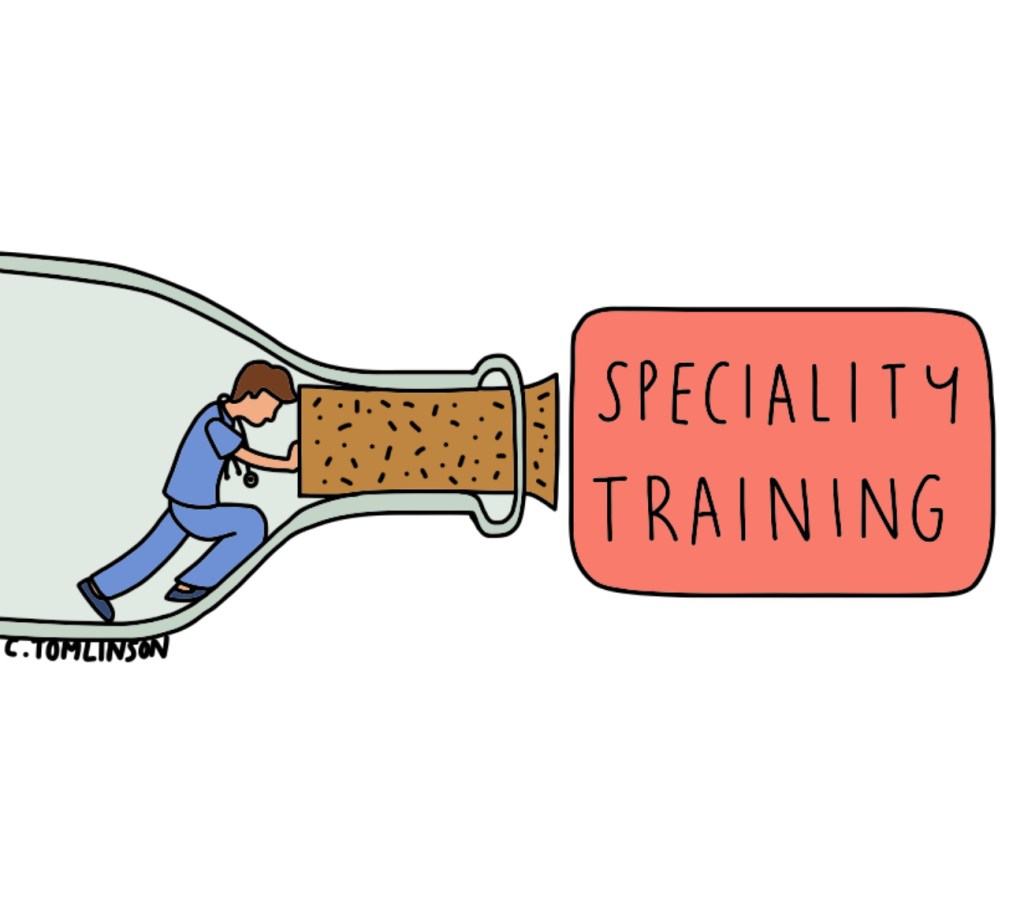
For doctors starting out – residents, registrars (“resident doctors” in the UK) – the cost is huge. Exams, courses, building your CV to make you the best candidate… It’s very competitive. And it shouldn’t be this hard. We’ve all worked so hard to reach this point – medical school, exams – so accessing training shouldn’t be such a battle.
Another issue is job availability. There are many medical students, including international graduates from Australian medical schools like me – “Australian medical graduates” (AMGs) who are still foreign – plus international medical graduates (IMGs) from overseas. But there aren’t enough jobs for everyone. So when you apply for internship, you may be “bottom of the list” even if you graduated from an Australian medical school. Sometimes people don’t get a job or have to relocate. It can be tough.
There are other issues too – long hours, roster problems – though this is the case all over the world. Also, the fact salaries haven’t kept up with inflation. Western Australia is better than the east coast, where there were recent strikes; the public often assumes all doctors earn a lot, but trainees definitely don’t.
Charlotte: That’s interesting you say that, because pay is a major issue in the UK right now too, with strikes taking place at the moment over pay, training post bottlenecks and doctor unemployment. Many doctors think pay is much better in Australia. But it sounds like you’re facing similar challenges.
Koushi: Yes. Colleagues from the UK do say the salary here is better. But when you factor in the cost of living, and the fact that salaries haven’t risen with inflation, you notice it.
Charlotte: And I think, although it probably does depend where you’re working, your rotas can be brutal too. Our hours are subject to the European Working Time Directive (EWTD) (unless you opt out) which helps – I have a friend working in Australia who has just finished a rotation where she worked 7 night shifts in a row, then had 7 days off. We never have more than 4 night shifts in a row in the UK.
Comparatively, doctors in Australia are paid more than in the UK. But I wonder how much of that is due to the hours that you’re working?
Koushi: I don’t know, but that’s a very interesting question.
Editor’s note: I did bit of digging on this – the basic doctor salary in Australia is higher than in the UK (so this is irrespective of the hours worked).
What’s the Appeal for UK Doctors?
Koushi: Lifestyle is a huge factor. It’s sunny almost everywhere, people are friendly, everyone smiles, and the beaches are amazing. You can travel easily across Australia, and even to Asia. The lifestyle is good here.
Charlotte: And do you feel you get a good work-life balance, too?

Koushi: I have a friend who moved from the UK a couple of years ago. She was a registrar, and she loved it. She had a great salary, and felt that she had a great work-life balance.
But there are pros and cons – once you live here longer, you start to notice the challenges too. I love Australia though, we have a good life here. You become very chill!
Are There Any Misconceptions About What It’s Like To Work as a Doctor in Australia?
Koushi: I think people can be surprised by cultural differences! For example, people walk around barefoot or in pyjamas – things you wouldn’t do in Europe.
The other thing is that some people assume it’s easy to find a job, too. But often you have to apply in multiple places, be open to rural locations, and it is a long process to get your full AHPRA* registration.
Editor’s note: AHPRA stands for the Australian Health Practitioner Regulation Agency, and you must be officially registered with them to practice as a health professional in Australia.
Koushi: I thin
Do UK Doctors Adapt Well to the Australian Health System?
Koushi: I think that there are a few things that can be challenging which can made adapting harder.
Everything is different: the environment, hospital culture, procedures, and software. Even within Australia, moving between hospitals requires adapting to new systems and ways of working. It can be a big adjustment, even if you’ve trained locally.
Charlotte: Yeah, it must be a big change. It’s the same across the UK too. Where I trained, we still had paper notes and paper prescribing charts. When I started work in the North West, that was the first time I’d ever used an electronic prescribing system.
Do You Have Any Advice For Doctors Thinking of Moving?
Koushi: Definitely do it. I’m a big believer in moving around; you learn a lot, you grow as a person, and you learn a lot in terms of culture, people. Get things ready in terms of your visa, and, of course, make sure you have a job before you move.
Charlotte: That’s good advice. I’ve heard that recently it is harder to find a job – so many people are moving to Australia from abroad, does this put more pressure on the system, in a way?
Koushi: Yes, although but they can definitely work with rural positions if they are open to it. There are always jobs around in Australia, especially in healthcare. Try not to be discouraged if you don’t get a job immediately.
Do You Think You’d Ever Work in The UK?
Charlotte: (And you can say no!)
Koushi: I don’t know. My husband and I thought about maybe working in Norway for a bit, but we are very comfortable in Australia and love working in the rural setting. I probably wouldn’t mind working six months or a year if my husband wants to.
In Summary
Amid growing frustration with training bottlenecks, pay erosion, and job insecurity in the NHS, more UK doctors are exploring a move to Australia – a country often idealised for its sunshine, lifestyle, and seemingly smoother healthcare system.
But as Dr Kirtee “Koushi” Conhyedoss explains, the reality is far more nuanced. Australia offers excellent clinical experience, better baseline pay, and a famously relaxed lifestyle, yet it also faces GP shortages, long waits, fierce competition for training places, and the same systemic pressures seen in the UK.
For many doctors the move is still worth it – but understanding the real challenges behind the beach-side allure is essential before taking the leap “down under.”
I’d love to hear your thoughts! Are you thinking about working in Australia? Or if you’ve already made the move, are you glad you did so? Leave a comment down below.
More About The Speaker
Dr Kirtee Koushi Conhyedoss was born in Mauritius, grew up in France, and later moved to Australia, where she completed her medical training. She now works in Emergency Medicine in Perth while pursuing her career through the Royal Australian College of General Practitioners (RACGP) – a unique position that allows her to keep one foot in the intensity of ED and the other in the continuity and depth of general practice.
She is also the creator of The Junior Doctor Series: The Unspoken Truth, a podcast that lifts the curtain on the realities of medical training – burnout, identity, racism, and the conversations medicine has avoided for far too long. I recently had the pleasure of being a guest speaker on her podcast – in this episode, we explored the art of communication, what it means to hold compassion in challenging environments, and the quiet strength that comes from reflection. If you’d like to have a listen, I’ve linked it below!
Known for her directness, honesty, and grounded compassion, Koushi brings a rare combination of sharp insight and human depth to her work. She speaks openly about the system’s failures and the resilience of the people within it, giving voice to experiences doctors carry but rarely share. Whether in the hospital or behind the microphone, she is committed to telling the truth – and making space for others to do the same.
 The Health and Healing Narrative
Leave a comment