
I am writing this blog post today from the hot and humid Saint Vincent and The Grenadines, in the Caribbean – my new home for the next 2 weeks. It is a refreshing change from the cold rainy weather of the North West, as the temperature here rarely drops below 25 °C – and that’s in the winter too.
My good friend who I’m visiting, also a Doctor in the NHS who is working out here, keeps reminding me that the UV index is 11 – “extreme”, and that my fair skin won’t “fair well” if I don’t keep applying sun cream regularly. So, as I sit here, sipping on a Rum Punch and sunning myself on the beach, I am reminded of the importance of balancing our enjoyment of the sun with proper skin protection.

Melanoma is a type of skin cancer that develops in the melanocytes – the cells responsible for producing melanin – the pigment that gives our skin its colour. It’s the most dangerous type of skin cancer, as it has the potential to metastasise (spread around the body). There are other types of skin cancers too, including Basal Cell Carcinomas (BCCs) and Squamous Cell Carcinomas (SCCs), but we will touch on these another time.
Melanomas differ from benign melanocytic naevi, a.k.a. moles. Moles occur when the melanocytes in our skin proliferate (grow); they are non-cancerous lesions, however, if the cells within them become damaged by the sun they can become cancerous, though this is rare.
Since the early 1990s, incidence rates of melanoma have increased by 147%; it is now the 4th most common cancer in males in the UK, and the 5th most common in females. This will be partly due to increased patient and healthcare practitioner (HCP) awareness, but also due to increased sun exposure all year round with reduced costs of holidays and rising ambient temperatures due to climate change.

Risk Factors.
- Excessive UV exposure from both natural and artificial light e.g., sun beds. 85% of melanomas are caused by this.
- According to the World Health Organisation (WHO) – people who have used a sunbed at least once at any stage in their life have a 20% higher risk of developing melanoma than people who have never used a sunbed, and the first use of sunbeds before the age of 35 increases the risk of developing melanoma by 59%.
- Intermittent UV exposure – people who are exposed to strong sunlight every so often e.g., when on holiday in a hot country, are at higher risk than people who are regularly exposed e.g., when working outdoors.
- History of sunburn – the risk is higher if multiple episodes, and especially if they occurred during childhood though the risk applies to all ages; even if sun cream is used later, the risk still persists.
- Fairer skin – melanomas can occur in people of any skin type, but people of fairer skin types e.g., Fitzpatrick type 1 (always burns, never tans) or type 2 (usually burns, tans with difficulty) are at greater risk.
- Having many moles on your skin, especially if >100.
- Family history of melanoma, especially if a family member had it below the age of 30, or more than one 1 first degree relative has it (1st degree being parents or siblings).
- Other medical conditions, including inflammatory bowel disease or a weakened immune system (for example due to HIV, or if on immunosuppressants).

How Does Sun Exposure Increase Our Risk?
The sun rays contain two different types of ultraviolet radiation* called UV A and B.
*Ultraviolet radiation = energy that comes from the sun; rays of energy that we cannot see.
UVA:
- Is present all year round.
- Can penetrate deeper into the skin.
- Can pass through windows.
- Contributes to premature skin aging and skin cancer risk.
- Damages our skin, causing us to tan.
- Is the primary radiation in sun beds.
- Makes up 95% of UV radiation.
UVB:
- Is more intense during spring and summer (especially between 10am and 4pm – the “midday sun”).
- Cannot pass through windows.
- Typically affects the epidermal (top) layer of the skin.
- Is the main cause of sunburn.
- Damages skin cells and causes changes to our DNA, therefore playing a significant role in increasing skin cancer risk.
- Can also damage our eyes, causing cataracts.
- Makes up 5% of UV radiation.

Suspicious Moles – The A to E of Melanoma.
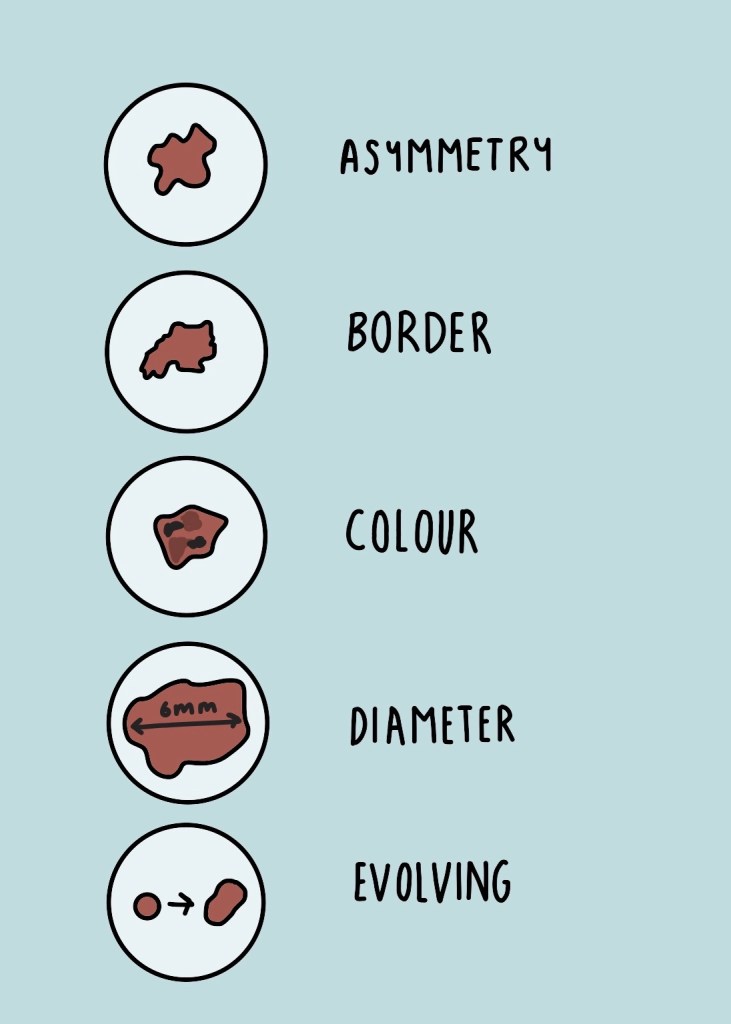
As melanomas have the potential to metastasise, the key is prevention and early detection. One of the methods you can use to help spot a melanoma early is the ABCDE method:
A = asymmetry.
- If you were to draw a line through the middle of the mole, both sides should match. If they’re not identical, this can be a sign.
B = border.
- If the border is jagged or irregular, this can be a sign too. Benign melanocytic naevi (moles) that are non-cancerous, typically have round, regular borders.
C = colour.
- Is it one colour, or is there more than one colour? Multiple different shades within can be a sign; Look for different shades of brown, tan, or black. As melanomas progress, red, white, or blue may appear too.
D = diameter.
- A larger diameter, especially if >6mm (around the size of a rubber on a pencil), can be suggestive of melanoma.
E = evolving.
- Any changes in appearance, including shape, size, elevation, or any new symptoms including itching or bleeding, can be concerning.
When healthcare practitioners (HCPs) examine moles, they typically use the Glasgow 7-point checklist. This splits certain characteristics into major and minor ones, giving them different points accordingly:
Major criteria:
- Change in size.
- Irregular shape.
- Irregular colour.
Minor criteria:
- Largest diameter is 7mm or more.
- Inflammation.
- Oozing.
- Change in sensation.
If the score is 3 or more, this is more concerning for melanoma.
Prevention Is Key.
If you take one thing away from this article, applying an SPF regularly is the best thing you can do for your skin; sun protection is the first line of defence.
Opt for sun cream with an SPF of at least 30 with both UVA + UVB coverage. Apply it at least 15 minutes before going out into the sun and reapply every 2 hours and after going in water. You need around 30ml (roughly one full shot glass) to cover your whole body, and make sure to pay special attention to commonly missed areas including the back of your neck and ears.
It’s important to use sun cream even when it isn’t sunny – always remember to check the UV index before leaving the house too, as the higher the UV the greater the risk. Sun cream will not completely block the sun’s rays either (and don’t worry, you’ll still get that golden glow for this reason too!), so other precautions need to be taken when out in the sun.
Opting for brands with high levels of UVA and UVB protection (at least 4-star) is important. A good example is La Roche-Posay’s Anthelios range – click the link below for more:
- As much as possible, cover up – wear protective clothing including hats and long-sleeved shirts.
- Seek shade, especially when UV rays are at their strongest.
- Avoid sun beds.
- Look for sunglasses that offer 100% UV protection (check the label for this!).
Make sure to see a doctor if you notice a new spot on your skin, one that looks different to others, one that is changing in shape/size/colour, or one that is itchy or bleeds.
Management.
If your HCP is concerned you may have a melanoma, a “two-week wait” referral will be made for you to see a Dermatologist who is specialised in diagnosing and treating skin conditions, including melanoma.
A Dermatologist will look at it with a dermatoscope (a device that is like a special magnifying glass for looking at the skin!), and a biopsy may be taken, though generally if a Dermatologist is concerned they will remove it in its entirety without waiting for a biopsy result to confirm.
In Summary.
Melanoma is something we all need to be aware about – it is a cancer, and can spread, but with the right knowledge and preventative measures we can significantly reduce our risks.
So, whether you’re lounging on a beach in the Caribbean or stepping out for a quick errand, remember to put your skin first – if you notice any unusual changes in your skin, seek medical advice promptly to ensure the best possible outcome.
Remember, nearly 90% of melanomas are preventable – make sure to share this post with your friends, family, and colleagues, so we can all be safe in the sun together. ☀️
Feel free to leave a comment down below, whether it’s sharing your thoughts on melanoma awareness or advice on how you protect your skin everyday – I’d love to hear from you. 🙌🏻
5 responses
-
don’t forget ‘the sunscreen song’
LikeLike
-
A classic! “Trust me on the sunscreen” – it’s true!
LikeLike
-
-
LikeLike
-
I love the visuals on this one! New to the sunscreen song.
In Aus the fear of sun exposure is forced upon everyone from such a young age that it’s almost a sin to not wear it on a daily basis, along with physical protection like sun hats. It also much more commonplace here to get full body skin checks, which I think must be a contributing to the stats that there are more deaths per year from malignant melanoma in UK than in Australia!
LikeLike
-
It’s really interesting to hear how the UK’s approach differs from that of Australia. I think having regular skin checks is a great idea – I know in America too people are generally advised to have skin checks every couple years. Though we’re not exposed to as much sun all year round in the UK, with the number of people holidaying abroad increasing and with the UK’s climate changing too, perhaps promoting regular skin checks would help reduce the mortality rate here too?
Thank you for sharing.LikeLike
-


References.
Most references are hyper-linked throughout the article – see highlighted text.
https://pmc.ncbi.nlm.nih.gov/articles/PMC10741796/#B35-cancers-15-05868
*This post contains an affiliate link, and I receive a commission if you visit a link and buy something on my recommendation; as an Amazon Associate I earn from qualifying purchases.
 The Health and Healing Narrative
Leave a reply to Charlotte Cancel reply