
Just last week I found out that I had successfully secured a place in General Practice specialty training starting August this year. It should have been a moment of unbridled celebration – and it was, for a minute. But as the congratulatory messages rolled in, so too did the sinking feeling that many of my equally qualified, brilliant colleagues didn’t make the cut this year.
Some are now applying for the third, fourth, or fifth time. Some are working in non-training jobs, unsure if they’ll ever be able to progress. Some are even faced with the fear of unemployment when their current training posts ends, forced to look at alternative careers. Many are looking abroad.
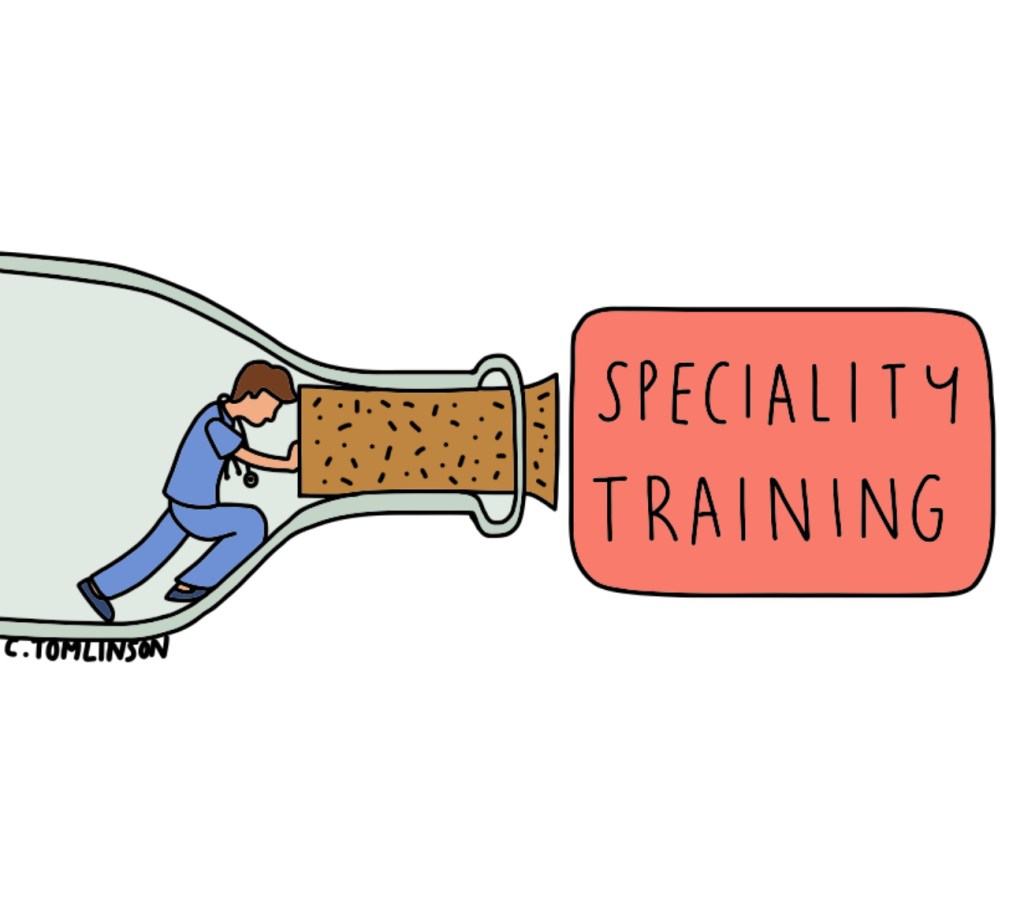
We’re constantly told the UK needs more doctors. And it does, nearly 50,000 in fact, to meet the OECD EU* average of 3.7 doctors per 1,000 people. But here’s the uncomfortable truth: we have doctors, but we don’t have enough training posts to support them. This is the bottleneck at the heart of the NHS workforce crisis.
*OECD EU = Organisation for Economic Co-operation and Development, an international organisation that aims to ‘build better policies for better lives‘.
Understanding the UK Training Pathway
To understand this crisis, let’s start with how Doctors are trained in the UK:
- Medical school: This takes on average 4-6 years depending on whether it is an undergraduate or postgraduate program.
- Foundation training (FY1 + FY2): A mandatory 2-year programme for newly qualified doctors. In FY1, doctors practice under provisional registration. After successful completion, they progress to FY2 and receive full registration with the GMC*.
- Speciality training: After Foundation, doctors apply to specialty training in one of over 60 specialties. Some programmes (like GP) are “run-through,” while others require an additional application after initial core training to progress to higher speciality training. Specialty training can last anywhere from 3 (for GP) to 7+ years for most other specialities.
- Consultancy: At the end of this process, doctors become eligible to apply for consultant posts.
*GMC = General Medical Council. This is the regulatory body that ensures that every doctor, physician associate (PA) and anaesthesia associate (AA), has sufficient knowledge, experience, and qualifications to practice within the UK.
The Numbers Don’t Add Up
The UK ranks third lowest in terms of the ratio of doctors to patients among comparable countries according to the OECD EU figures. To address this the government is expanding the number of medical school places as part of the NHS Long-term workforce plan, aiming for 15,000 places per year by 2031/32. These figures sound promising, but what happens after graduation?
Last year, over 1,000 UK medical graduates were offered “placeholder” Foundation posts— an offer of employment, despite their job not existing yet. These doctors faced potential long delays in knowing where they’d be placed or what rotations they would have, having to wait whilst emergency posts were created and often having to relocate at short notice. It’s a chaotic start to a career that demands clarity and support.
Meanwhile, further down the training pipeline, the numbers are even more sobering.
Take General Practice with Public Health Medicine, for example. Though a more extreme example, in 2024, there were 1,794 applicants for just 16 posts. That’s a staggering 112 applicants for each place.
Even specialties that have traditionally been easier to enter, like General Practice, are becoming oversubscribed and hyper-competitive. In 2020, there were 5,770 applicants for 3,836 GP training posts. This year, 15,441 doctors applied for just 4,096 GP posts, meaning only 1 in nearly 4 applicants landed a training post.
The overall result – an estimated 20,000 doctors will miss out on speciality training this August due to lack of formal training posts. Many instead will work as non-training grade doctors —“clinical fellows”, “trust grade” doctors, or as is increasingly common, working on the Bank as an “FY3″ (or 4, 5, 6+) — with no guaranteed career progression, no structured training, no guaranteed job, and limited support.
So, next time it takes 3 weeks to get a GP appointment, I ask you to please remember the following:
- A full-time GP in the UK is responsible for an average of 2,257 patients.
- They have roughly 223 days in a year to see patients, after weekend days, bank holidays, and 30 days of annual leave have been deducted. This does not account for other work-related commitments.
- In 2015, the average number of times a patient would see their GP in a year was 7.
- That equates to 15,799 appointments per GP over a 223 day period, or 70.8 appointments a day.
- The European Union of General Practitioners and BMA suggest that a GP should see no more than 25 appointments in one day, in order to be able to deliver safe care.
It is evident that we need more GPs to meet increasing demands, as current workloads are unmanageable. Yet, this year, 11,345 applicants weren’t able to get into GP training. The numbers don’t add up.
So Why Aren’t There Enough Training Posts?
Despite the clear need for more doctors, the UK has failed to expand speciality training posts at the necessary rate. Key reasons include:
- Postgraduate Medicine is Underfunded
- While medical school places have increased, the funding to support doctors after graduation hasn’t kept pace.
- Lack of Strategic NHS Workforce planning
- This includes the distribution of training posts, which are frequently based off historical arrangements. Workforce planning has always been largely reactive, aiming to “fill gaps”, rather than proactive, intending to prioritise long-term patient need.
- Consultant and Senior Staff Shortages
- Supervising trainees takes time — and consultants who are already stretched thin may not be able to support more juniors, even if the funding exists. This creates a secondary bottleneck: not just in posts, but in capacity to train.
- Limited Incentives for Trusts to Create Posts
- Trusts may prefer hiring non-training doctors to “fill gaps” — these roles offer more rota flexibility and less administrative burden compared to training posts, which come with added oversight and governance requirements.
- Mismatch Between Training Locations and Workforce Needs
- Even where posts are created, they may be located in areas with poor transport links, housing shortages, or low staff retention, making them unattractive or unsustainable for many doctors.
The Rise in International Medical Graduates (IMGs)
Another factor contributing to the bottleneck is the sharp increase in International Medical Graduates (IMGs) applying for the same training posts.
- In 2023, there were 9,273 UK graduates and 10,402 IMGs applying for specialty training posts.
- In 2025, those numbers rose to 12,305 UK graduates and 20,803 IMGs.
The NHS has always relied on IMGs, and they are an invaluable part of the workforce. But without a proportional increase in training posts, competition rises, and more doctors — both UK and international — are left without progression.
The Hidden Human Cost
This isn’t just a numbers game. There are real emotional, psychological, and economic consequences for doctors caught in the bottleneck, and significant knock-on effects for the patients they care for.
For many doctors, life is put on hold. Buying a home, settling down, or starting a family becomes impossible without job security. Instead, they move year-to-year on short-term contracts, often without knowing what will come next.
Burnout is rife. Understaffed teams lead to overworked doctors, who face rising rates of stress, exhaustion, and mental health struggles. Non-training roles often mean lower pay, fewer rights, and little to no access to structured learning — despite working the same long shifts under the same pressures.
And when these doctors leave — for Australia, New Zealand, or other careers entirely — we don’t just lose people. We lose potential GPs, surgeons, psychiatrists, and so on. It costs an estimated £230,000 to train each doctor in the UK; that’s a staggering waste of talent and money too.
Most importantly, it’s patients who suffer: longer waiting times, lack of access to specialist services, and reduced quality of care.
Why Are Doctors Leaving The UK?
Frustrated by the lack of career opportunities, many UK-trained doctors are looking abroad for better prospects. Australia and New Zealand have become particularly attractive destinations in recent years due to:
- Better pay: Australian junior doctors can earn more than their UK counterparts, though this does vary by job and experience. For example, UK Consultants are paid between £105,504 – £139,992, whereas equivalent roles in Australia are paid between £190,000 – £243,000.
- More training opportunities: Specialist training is more accessible, budgets for spending on career development tend to be higher.
- Work-life balance: Doctors often report better conditions and work environments.
- Disillusionment with UK Politics: Many feel undervalued, overworked, and ignored by policymakers.
What Needs To Change?
To fix the bottleneck, we need more than just political promises.
- Expand training posts – now: We need a commensurate increase in the number of training posts to match the rise in medical school places.
- Guarantee jobs after training: We need to ensure doctors have a viable career path after completing training.
- Invest in Postgraduate education: Allocate targeted funding to create more learning opportunities, flexible training pathways, and structured teaching for doctors at all stages.
- Introduce structured support for non-training doctors: Provide formal teaching, mentorship, and career progression frameworks for doctors in trust-grade or Bank roles who haven’t be successful in applying for training. Don’t leave them behind; they still need to learn, and are more than just “service provision”.
- Make retention a priority: Improve working conditions through better rotas, protected learning time, pastoral support, and give resident doctors a voice in decision-making. Show them they are valued.
The longer we delay, the more doctors we lose — and the more patients go without the care they need.
Final Thoughts
It is evident that we have a shortage of doctors in the UK, but the more imminent crisis is the lack of training posts that allow them to continue to work and progress in their careers. Until we address this, we will continue losing talent, wasting resources, and failing both our workforce and our patients.
Change isn’t impossible. It starts with recognising the problem, listening to those on the shop floor, and making decisions that prioritise people over politics. The solutions are clear. Doctors deserve better. Patients deserve better. We all do.
Have you been affected by the training bottleneck this year? If you, or someone you know, has ever been a patient within the NHS, how does this make you feel?
I’d love to hear your thoughts – please leave a comment down below.

 The Health and Healing Narrative
Leave a reply to UK Resident Doctors and the NHS Strikes: What’s Happened So Far – The Health and Healing Narrative Cancel reply